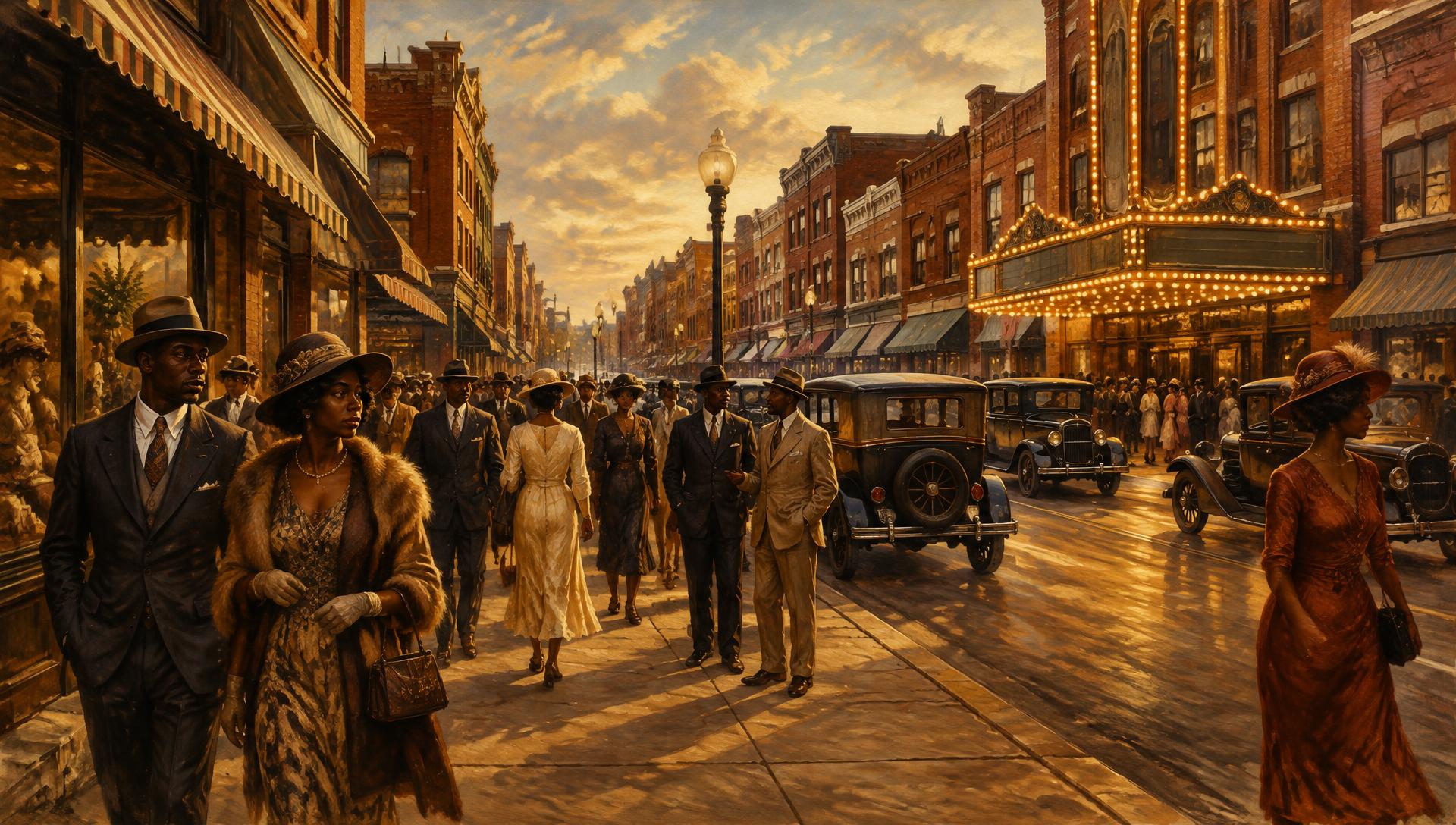
Documented Greenwood businesses from the Black Wall Street era, with owners and sources where verified.
Transportation
Berry's Jitney Service
Simon Berry
Greenwood district
Simon Berry ran a jitney taxi service for Greenwood residents and later operated a charter airplane service — one of the district's most entrepreneurial ventures.
Sources: Smithsonian NMAAHC
Theater
Dreamland Theatre
John Williams and Loula Williams
129 North Greenwood Avenue
A 750-seat theater opened in 1914 showing films and hosting live music and performances; a cultural anchor of the district. Destroyed in 1921 and later rebuilt.
Sources: Tulsa Historical Society and Museum
Grocery and lodging
Gurley's Grocery and Rooming House
O.W. Gurley and Emma Gurley
Greenwood Avenue
Among the first businesses in the district, established after Gurley's 1906 land purchase; the Gurleys eventually owned more than one hundred Greenwood properties.
Sources: Oklahoma Historical Society
Legal services
Law Office of B.C. Franklin
B.C. Franklin
Greenwood Avenue
Franklin's practice, destroyed in the massacre, reopened within weeks in a tent; he led the successful legal fight against the ordinance designed to block rebuilding.
Sources: Oklahoma Historical Society
Beauty salon
Little Rose Beauty Salon
Mabel Little
Greenwood Avenue
Mabel Little's salon served the women of Greenwood; she and her husband lost their home and businesses in the massacre and later published her memoir, Fire on Mount Zion.
Sources: Oklahoma Historical Society
Church
Mount Zion Baptist Church
North Elgin Avenue
Dedicated in April 1921 and burned to the ground weeks later in the massacre; rebuilt and rededicated in the 1920s as a symbol of the district's resilience.
Sources: Tulsa Historical Society and Museum
Hotel
Stradford Hotel
J.B. Stradford
Greenwood Avenue at Archer Street
Opened in 1918 with fifty-four rooms, a dining room, and a barber shop; considered one of the largest Black-owned hotels in the United States. Destroyed in the 1921 massacre.
Sources: Oklahoma Historical Society; Tulsa Historical Society and Museum
Newspaper
Tulsa Star
A.J. Smitherman
Greenwood Avenue
A fiercely independent Black newspaper that championed self-reliance and civil rights; its offices were destroyed in the massacre and Smitherman was indicted for his role in defending the community.
Sources: Oklahoma Historical Society
Church
Vernon AME Church
311 North Greenwood Avenue
Its basement was among the only structures to survive the massacre; the rebuilt church is the only standing Black-owned structure from the massacre era on Greenwood Avenue.
Sources: Tulsa Historical Society and Museum
Confectionery
Williams Confectionery
Loula Williams
Greenwood Avenue
The Williams family's candy and ice cream shop, managed by Loula Williams, helped fund the family's later ventures including the Dreamland Theatre.
Sources: Tulsa Historical Society and Museum